EASL MASLD Guidelines Implementation Programme
Programme Overview
This EASL Guidelines Implementation Programme is an 18-month educational project designed to support the use of the latest EASL–EASD–EASO Clinical Practice Guidelines (CPGs) for managing metabolic dysfunction-associated steatotic liver disease (MASLD). This initiative is part of EASL’s CPGs dissemination programme. Discover more here.
The project transforms CPGs into a series of interactive, practical learning activities. It begins with short quiz questions for the wider medical community and builds towards the EASL MASLD Guidelines Academy, which provides in-depth training on MASLD. Depending on the guidelines in focus, the programme may cover the full set of recommendations or concentrate on selected parts.
The programme is open to physicians across specialties — including gastroenterology, hepatology, endocrinology, diabetology, and general practice — as well as clinical researchers, nurses, and allied health professionals. It is designed to meet the needs of both early-career professionals and experienced practitioners.
The goal is to combine theoretical knowledge and practical tools, helping healthcare professionals apply the EASL CPGs effectively in everyday clinical practice.
🤝 Join us on this journey from fundamentals to advanced MASLD care, guided by the latest clinical expertise!
Start learning now!
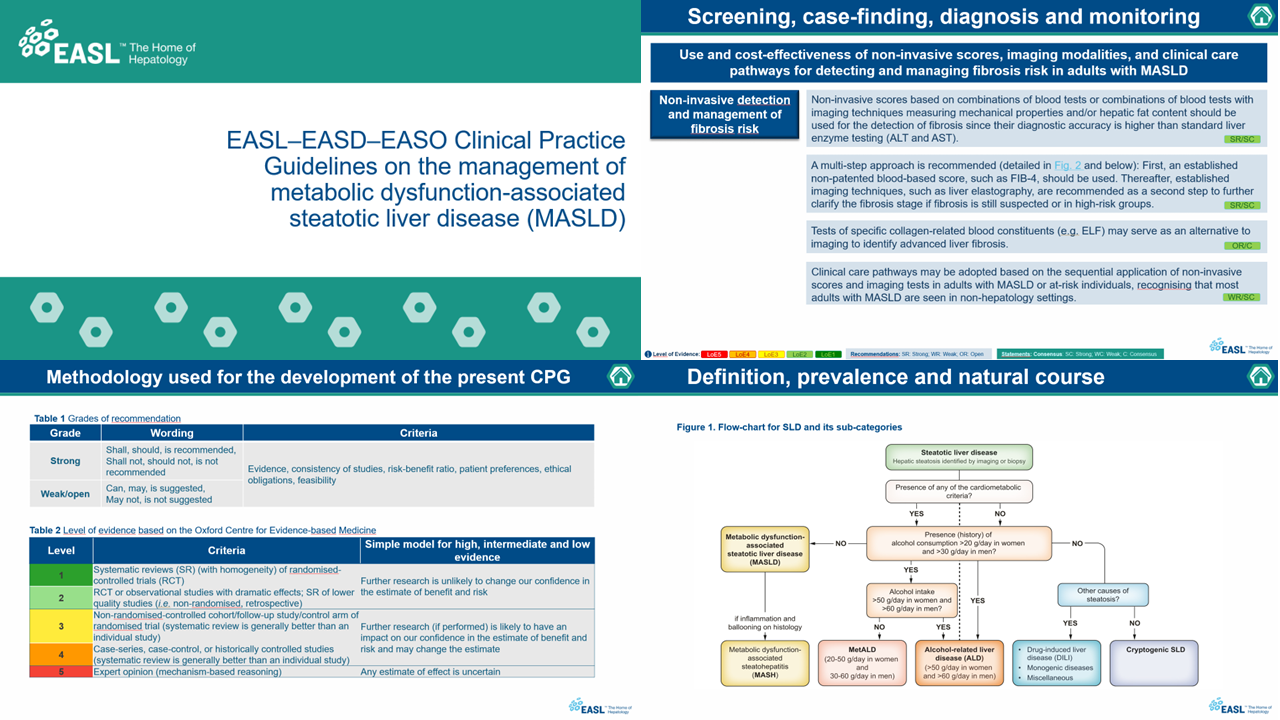 |
EASL–EASD–EASO MASLD CPGs Slide deckDownload an editable PowerPoint packed with key take-home messages from the latest CPGs. Perfect for clinical teaching, presentations, and sharing knowledge with your team: everything essential at your fingertips. |
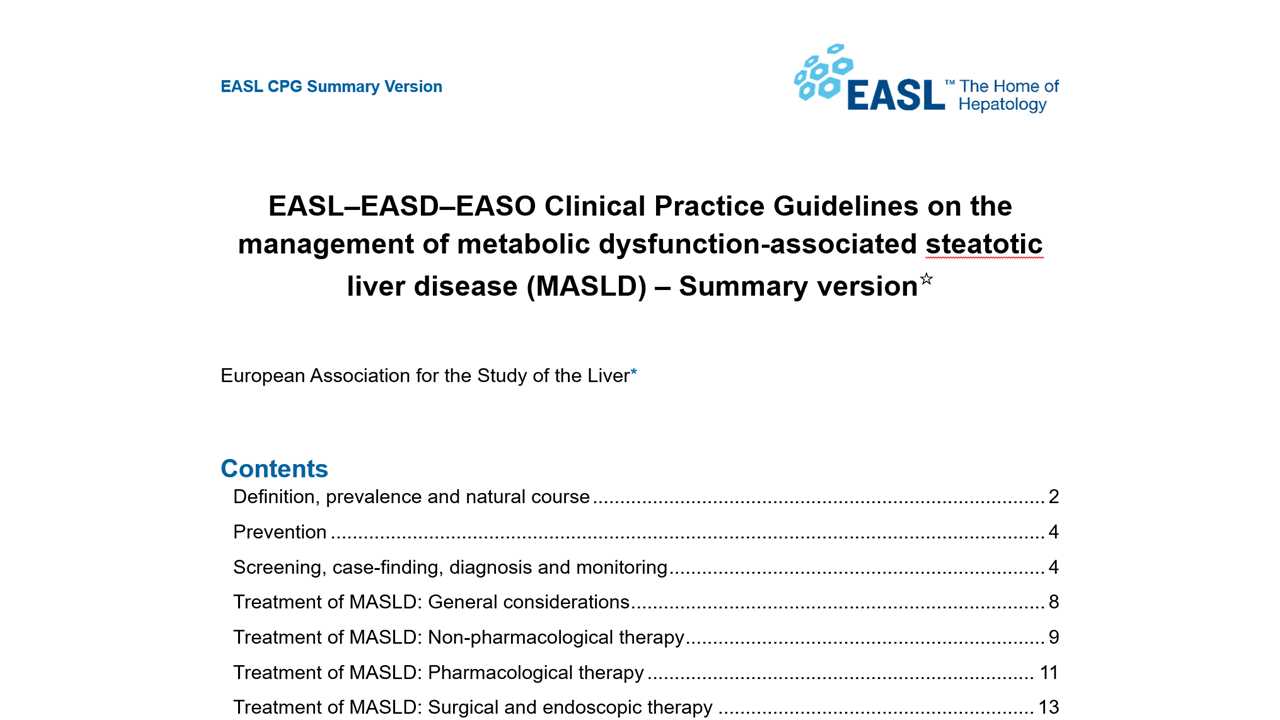 |
EASL-EASD-EASO MASLD CPGs Summary versionGet up to speed fast: these CPGs are now summarised in a sleek and compact new format! |
EASL QUIZ on the EASL-EASD-EASO MASLD CPGs
Read the case of this 64-years-old man and find the right answer!EASL QUIZ on the EASL-EASD-EASO MASLD CPGs
Read the case of this 56-years-old man and find the right answer!
EASL MASLD Guidelines Academy
The EASL Guidelines Academy is a training programme designed to help doctors, nurses, and other healthcare professionals learn to apply the latest official clinical guidelines in real-world practice.
This EASL Guidelines Academy focuses specifically on MASLD offering hands-on, intensive training so participants can:
- Understand the disease and its risks.
- Learn how to screen, diagnose, and treat patients effectively.
- Use the latest tests, scans, and procedures with confidence.
- Work effectively in a multidisciplinary team (doctors, nurses, dietitians, etc.).
- Promote awareness and prevention of liver disease.
The programme features four modules tailored for clinicians and one dedicated module for nurses and AHPs. Discover the programme below:
Module 1: The basics of MASLD
27-28 August 2026 | Angers, France
Organiser: Jérôme Boursier
Programme: Pathophysiology (basic level), epidemiology, natural history, rationale of screening, methodology of screening, correct use of NITs for screening/diagnosis; training in interpretation of NITs; training in elastometry; workshop on setting-up a screening programme.
Module 2: A deeper dive into MASLD
8-9 October 2026 | Antwerp, Belgium
Organiser: Sven Francque
Programme: Pathophysiology (expert level), insights into liver histology (standard and more advanced approaches) and the role of the liver biopsy, the role of liver imaging and other more specialized assessments; training in ultrasound; workshop on challenging cases in terms of diagnosis and severity assessment.
Module 3: Multidisciplinary management of the patient with MASLD
12-13 November 2026 | Aarhus, Denmark
Organiser: Henning Grønbæk
Programme: Therapeutic approaches and their pathophysiological background; practical use of incretins for different indications; MASLD management in the context of a general metabolic health approach; MASLD and cardiovascular-renal disease; liver-targeted drugs; HCC screening policies; workshop on primary and secondary care approaches/models of care.
Module 4: The specifics of advanced disease in MASLD
2-3 December 2026 | Prague, Czech Republic
Organiser: Sona Frankova
Programme: Clinical, pathological and pathophysiological considerations of MASH in the stages of advanced fibrosis and cirrhosis; specifics of diagnosis and monitoring in the advanced stage; the challenges and practicalities of management, including pitfalls in portal hypertension, the difficulties regarding surgery (including bariatric surgery), the selection for liver transplantation, the option for drug treatment, managing sarcopenia, frailty and malnutrition; workshop on advanced diagnostics; workshop on challenging cases of advanced disease.
Module 5: Multidisciplinary management and the role of nurses and other HCPs
17-18 September 2026 | Navarra, Spain
Organiser: Gema Frühbeck
Programme: Basic knowledge on MASLD, AUD and cardiometabolic comorbidities; organisation of multidisciplinary clinics in other disease areas (diabetes clinics, obesity clinics); workshop: tips and tricks for behavioural change; workshop: improving organisation around “metabolic health” in a complex ecosystem.
Training format: Blended learning
- Preparation: Participants prepare with online courses, videos, and tests.
- In-person Module: Participants attend a 2–3-day intensive course at a leading liver centre in Europe, working in small groups with experts.
- Follow-up: Participants complete follow-up online activities to consolidate learning.
Each Academy session is limited to around 30 carefully selected participants, ensuring a focused and interactive learning experience. Selection is based on professional background, experience in liver disease care, and motivation.
🚀 Get ready for the first-ever EASL Guidelines Academy, apply now by clicking on this link!
Upcoming content
CPGs Translation
Guidelines in your language
Access translated summaries of the CPGs, created with European National Associations. Clear, accessible, and ready to support clinical practice wherever you are.
Supporters
This programme has been supported by Boehringer Ingelheim, Novo Nordisk and Madrigal. Boehringer Ingelheim, Novo Nordisk and Madrigal have had no input or influence into the content of this programme.